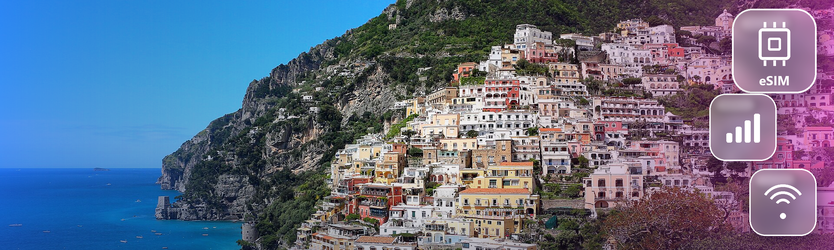
A Mediterranean eSIM is really a question disguised as a product: are you visiting one shore of this sea, or several? The Mediterranean is the rare region where a two-week trip can plausibly touch three countries without ever feeling rushed, and the right data setup depends entirely on how your route reads on a map. So read it like a map. Here is the coastline, west to east, and what each stretch means for your phone.
Spain: the western anchor
Spanish itineraries sprawl by nature: a city, a coast, an island, often all three. Data here does ticket apps, beach-day weather calls, and the late-night dinner culture that runs on last-minute searches. A Spain plan covers the mainland and island-hopping within the country on one purchase.
Italy: the long middle
Italy is the Mediterranean’s connector, the country most multi-stop routes pass through. Trains link the coast to the cities, and the Italy plan rides along for all of it. This is also where many travelers cross their first border of the trip, which is the moment single-country plans start to feel small.
Greece: the island question
Greece turns every data conversation into a ferry conversation. Coverage in the towns and ports is generally solid, and it can dip mid-crossing between islands, so bookings are better made on land than on deck. One Greece plan covers the mainland and the islands together; the ferries are a schedule problem, not a SIM problem.
Malta and Cyprus: the small giants
The sea’s two island nations punch above their size on Arab travel itineraries. Both are compact enough to cross in a day and busy enough to need same-day booking data. Each has its own plan, Malta here and Cyprus here, and both make natural add-ons to a bigger route.
The one-decision shortcut
Now count your countries. One country: buy its plan and stop reading. Two or more, or even a serious chance of two or more, and the arithmetic flips toward a single regional Europe plan that treats the whole coastline as one place. Borders stop mattering, the setup happens once, and the mid-trip decision to add an island or a neighbor costs nothing on the connectivity side. That flexibility is worth more than it sounds in July, when the trip you planned and the trip you take are rarely identical.
Whichever route you choose, the mechanics from Numero eSIM are the same: buy before you fly, install by QR on home wifi, confirm your handset on the supported devices list, and keep your home SIM in place with data roaming off so your number lives on while the eSIM pays the data bills.
The ferry question, answered once
Island summers raise one recurring worry, so here it is settled. Coverage near coasts and inside ports is generally dependable. Mid-crossing, out where the water goes wide, it fades for everyone regardless of provider, because there is no tower out there to reach. The fix is not a better plan; it is downloading tickets, arrival maps, and confirmations before you board, then treating the crossing as an hour off.
When a single country plan still wins
For balance, because regional is not always the answer. Two weeks in one Greek island group, no border in sight, returning from the same airport, is a single-country trip however Mediterranean it feels. Buying regional coverage for it means paying for flexibility you will not use. The test is not how the trip feels. It is whether your passport comes out of the drawer once you have arrived.
A sea that rewards planning once
The Mediterranean punishes travelers who solve connectivity per country: five queues, five setups, five chances to start a leg offline. Solve it once instead, before departure, and the sea becomes what it was supposed to be. For the ferry-heavy version of this trip, our Greek island-hopping guide goes deeper, and the international travel eSIM guide covers destinations beyond this coastline.
Frequently Asked Questions
What is the best eSIM approach for a Mediterranean cruise or ferry route?
Coverage at sea is never guaranteed on any plan, so treat crossings as offline time and do your booking in port. For the land portions, a regional plan handles multi-country stops without any changes between them.
Is a regional plan wasteful if I spend most of the trip in one country?
If one country truly dominates, its single plan is the tidy choice. The regional option earns its keep the moment a second country enters the itinerary, even briefly, because border days are the worst days to be sorting out data.
Do Mediterranean islands have reliable coverage?
Populated islands and ports are generally well covered. Remote beaches and mid-crossing stretches can thin out, which is normal everywhere and worth planning around rather than worrying about.
When should the setup happen?
At home, days before the flight, following the travel setup guide. A Mediterranean trip starts at an airport or a port, and neither is a good place to begin configuring a phone.
Does one plan really cover a Spain, Italy, and Greece summer?
That route is precisely what the regional option exists for: three countries, one installation, zero border-day admin. Country plans still win when a single shore holds the entire trip.